 College has been awarded grade ‘A’ for Cycle 2 of NAAC Accreditation


Department Convenor
Dr. Ramneet Kaur
Convenor
Dr. Nikhil Jain
About the Society
Civil Society: A Forum for Political Inquiry
Civil Society, the Academic Society of the Department of Political Science, Sri Guru Nanak Dev Khalsa College, University of Delhi, serves as a forum for intellectual engagement, critical inquiry and democratic dialogue. Rooted in the study of politics and society, the Society seeks to extend learning beyond the classroom by creating spaces where students, faculty, scholars and practitioners can engage with the ideas and questions shaping the contemporary world.
At its core, Civil Society is guided by the belief that a university is not only a place for acquiring knowledge, but also a space for questioning assumptions, examining competing ideas and cultivating the intellectual habits necessary for democratic citizenship. By bringing together academic inquiry and public engagement, the Society aspires to nurture a vibrant culture of discussion and make the study of politics an active, reflective and intellectually enriching experience.
The Society also seeks to foster an academic culture in which diverse perspectives can meet in conversation. National and international academic engagements, interactions with eminent scholars and public intellectuals, and interdisciplinary discussions provide students with opportunities to encounter perspectives beyond the conventional boundaries of the classroom. The emphasis is on thoughtful disagreement, reasoned argument and an openness to ideas.
The Society organises seminars, lectures, panel discussions, workshops, conferences, debates, competitions and other academic and co-curricular activities throughout the academic year. Its programmes engage with a wide range of themes in political science and allied disciplines, including democracy and constitutionalism, international relations, political economy, governance, political thought, public policy, social movements, contemporary global affairs, culture and society. Through these engagements, the Society encourages students to approach political questions not merely as subjects of study, but as matters requiring reflection, argument and informed public discussion.
Civil Society therefore seeks to be more than an activity-based student forum. It is envisioned as an academic community of inquiry—a space where ideas are debated, perspectives are challenged, questions are pursued and students are encouraged to develop the confidence to think critically and participate meaningfully in public life.
| OFFICE BEARERS | |||
|---|---|---|---|
| Serial No. | Name | Position | Course |
| 1 | Amit Nishad | President | PSC |
| 2 | Disha Sharma | Vice President | PSC |
| 3 | Anshul Bishnoi | Secretary | PSC |
| 4 | Gagandeep Singh | Joint Secretary | PSC |
| 5 | Garvit | Treasurer | BAP |
| 6 | Sannidhya | Technical Head | BAP |
| 7 | Shambhavi | Social Media Head | BAP |
| 8 | Shreya | Creative Head | PSC |
| 9 | Vedika | Content Head | PSC |
| 10 | Arpita | Public Relations Officer | PSC |
| 11 | Govindveer | Public Relations Head | PSC |
| 12 | Manpreet | Human Relations Officer | PSC |
| 13 | Gursimar Singh | Marketing Head | PSC |
| 14 | Janvi | Event Coordinator | BAP |
| 15 | Gundeep Singh | Executive Member | PSC |
| 16 | Ishneet | Executive Member | PSC |
| 17 | Dhananjay Sharma | Executive Member | BAP |
| 18 | Taranpreet | Executive Member | PSC |
| 19 | Ishmeet | Executive Member | PSC |
| 20 | Jasnain | Executive Member | PSC |
| 21 | Additri | Executive Member | PSC |
| 22 | Gurnoor | Executive Member | PSC |
| 23 | Jassimar | Executive Member | PSC |
| 24 | Neha | Executive Member | PSC |
| 25 | Sakshi | Executive Member | PSC |
| 26 | Shivang | Executive Member | PSC |
| 27 | Shubhangi | Executive Member | PSC |
| 28 | Ishvindar | Executive Member | PSC |
| 29 | Ajay | Executive Member | PSC |
| 30 | Parul | Executive Member | PSC |
| 31 | Priyanshi | Executive Member | PSC |
| 32 | Yashrib | Executive Member | PSC |
Decolonising International Relations: Perspectives from the Global South
Civil Society organised a talk on “Decolonising International Relations: Perspectives from the Global South” on 22 September 2026, featuring Prof. Nirmal Jindal, Former Principal Satyawati College, University of Delhi and Dr. Kamal Kumar, Sr. Assistant Professor, School of Global Affairs, Ambedkar University, New Delhi as speakers. The discussion explored the dominance of Western frameworks in the study of International Relations and examined the need to broaden the discipline through perspectives, experiences and intellectual traditions from the Global South. The session encouraged critical reflection on how global politics is studied, interpreted and represented, followed by an engaging exchange of ideas among the participants.
Relevance of Indian Knowledge System in Contemporary India
Civil Society organised a Special Academic Session on “Relevance of Indian Knowledge System in Contemporary India” on 15 September 2026. The session featured Prof. Sanjeev Kumar Sharma, General Secretary and Treasurer, IPSA as the speaker and Dr. Nancy Pathak, Assistant Professor, Department of Political Science, Lady Sri Ram College, University of Delhi as the Chair. The discussion examined the intellectual traditions of the Indian Knowledge System and their continuing relevance to contemporary questions of society, politics, education and public life. The session encouraged critical engagement with India’s knowledge traditions and their place in shaping contemporary thought and practice.
Global Justice
Civil Society organised a talk on “Global Justice” on 25 August 2026, featuring Prof. Thomas Pogge, Yale University, USA, as the speaker. The discussion examined key questions surrounding global justice, including inequality, poverty, human rights and the ethical responsibilities of individuals and institutions in an interconnected world. The session provided participants with an opportunity to engage critically with contemporary debates on justice beyond national boundaries and to reflect on the moral and political challenges facing the global order.
INSIGNIA – The Civil Induction Ceremony
Civil Society organised “INSIGNIA – The Civil Induction Ceremony” on 14 August 2026 to mark the selection and induction of its new office bearers. The ceremony brought together students for a formal badge and office-bearer induction, symbolising their transition into positions of responsibility within the Society. The programme included lamp lighting, the Shabd ceremony, pot distribution, and the introduction and nomination of office bearers. The occasion also featured addresses by Dr. Ramneet Kaur and Dr. Nikhil Jain, who encouraged students to approach their responsibilities with commitment, initiative and a spirit of academic engagement.
Politics, Economy and Media Culture: Amid Global Transitions
Civil Society, in collaboration with the KIRT Society and Kalam Society, organised an Interdisciplinary International Seminar on “Politics, Economy and Media Culture: Amid Global Transitions” on 27 February 2026. The seminar brought together diverse perspectives on the changing relationship between politics, economic transformations and media culture in an increasingly interconnected world. With contributions from Prof. Sushma Yadav, Prof. Ashok Mittal, Dr. Neelam Choudhary, Prof. Rawail Singh, Prof. Amanpreet Singh and Ms. Kamalpreet Kaur, the event provided a platform for critical dialogue on contemporary global transitions and their implications for political, economic and cultural life.
Beyond Dreams: The Ground Realities of Studying Abroad
Kalam Society and Civil Society organised an International Student Enrichment Programme on “Beyond Dreams: The Ground Realities of Studying Abroad” on 10 February 2026. The session featured Sardar Gurshminder Singh, a journalist and social activist based in Australia, who offered insights into the realities of student life abroad beyond its often-glamorous portrayal. The discussion addressed challenges such as homesickness, loneliness, cultural differences and the pressures of adapting to a new social and academic environment. The session encouraged students to approach the prospect of studying abroad with greater awareness, preparedness and a realistic understanding of the experience.
National Seminar on Indian Political Thought: Ideas and Institutions
Civil Society organised a National Seminar on “Indian Political Thought: Ideas and Institutions” on 10 November 2025. The seminar brought together scholarly perspectives on the diverse intellectual traditions of Indian political thought and their relationship with political and social institutions. The discussions explored key ideas, thinkers and institutional frameworks that have shaped the Indian political tradition, providing participants with an opportunity to engage with the richness and continuing relevance of Indian political thought.
TAQREER – Debate Competition
Civil Society organised “TAQREER,” a debate competition, on 28 August 2025, centred on the theme “Can a nation be truly independent in a globalised world today?” The debate provided students with a platform to engage critically with questions of national sovereignty, globalisation and interdependence. It encouraged participants to develop reasoned arguments, engage with differing perspectives and articulate their views on a complex question of contemporary politics.
Multilingualism & Nationalism
Civil Society organised a talk on “Multilingualism & Nationalism” on 28 August 2025, featuring Prof. Bandana Jha as the speaker. The discussion explored the relationship between language, identity and nationalism, with particular attention to the ways in which linguistic diversity shapes ideas of belonging, citizenship and national identity. The session provided students with an opportunity to engage with the complexities of multilingual societies and the politics of language in contemporary India.
Intra-College Speech and Poster-Making Competition
Civil Society organised an Intra-College Speech and Poster-Making Competition on 8 April 2025 at the Seminar Hall. The event provided students with a platform to express their ideas and perspectives through both spoken and visual forms. The competitions encouraged creativity, critical thinking and effective communication, while fostering an engaging environment for students to articulate their views on contemporary issues.
Celebrating International Working Women’s Day in Contemporary Times: History, Relevance and Challenges
Civil Society organised a talk on ‘Celebrating International Working Women’s Day in Contemporary Times: History, Relevance and Challenges’ on 26 March 2025, featuring Prof. Krishna Menon as the speaker. The discussion traced the historical significance of International Women’s Day and examined its continuing relevance in the contemporary world. It addressed key challenges confronting working women, including questions of equality, rights, representation and participation in social and professional life. The session provided students with an opportunity to reflect critically on the changing realities of women’s work and the broader pursuit of gender equality.
Modern State and Democracy in India
Civil Society organised a talk on ‘Modern State and Democracy in India’ on 7 March 2025, featuring Prof. Ujjwal Singh as the speaker. The discussion examined the evolution and character of the modern state in the Indian context and its relationship with democratic institutions and practices. It explored questions of political authority, citizenship, representation and the functioning of democracy in contemporary India. The session provided students with an opportunity to critically engage with the complexities of the Indian state and the challenges of sustaining democratic politics.
New Frontiers in the Register of Migration and Refugee Studies
Civil Society organised a talk on ‘New Frontiers in the Register of Migration and Refugee Studies’ on 24 February 2025, featuring Prof. Nasreen Chowdhory as the speaker. The discussion examined emerging debates in migration and refugee studies, with attention to changing patterns of displacement, mobility, identity and belonging. It explored contemporary challenges surrounding migration and the evolving ways in which refugee experiences are understood within academic and public discourse. The session provided students with an opportunity to engage critically with questions of migration, displacement and human rights in the contemporary world.
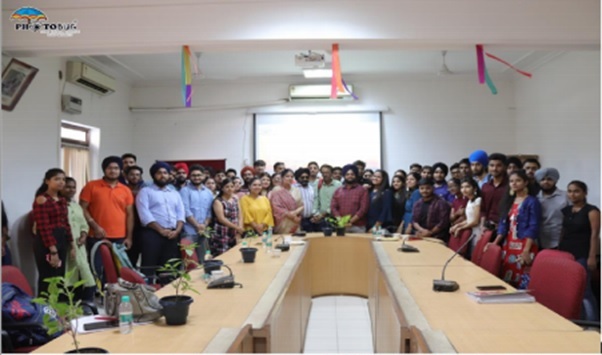
Seminar on "Career options for Political Science students" by Professor Dr. Abhay Prasad Singh
© Sri Guru Nanak Dev Khalsa College